For schools · Proposal
Dance games in PE: an eight-week unit that keeps every student moving
Dance games reach the kids who usually avoid exercise: no sports experience needed, just a beat and a few arrows. One StepManiaX dance machine becomes one of four rotating stations, so every student plays a song on the machine every class and nobody waits in line.
Pilot it at your school See how a class runs
Program documents and demo
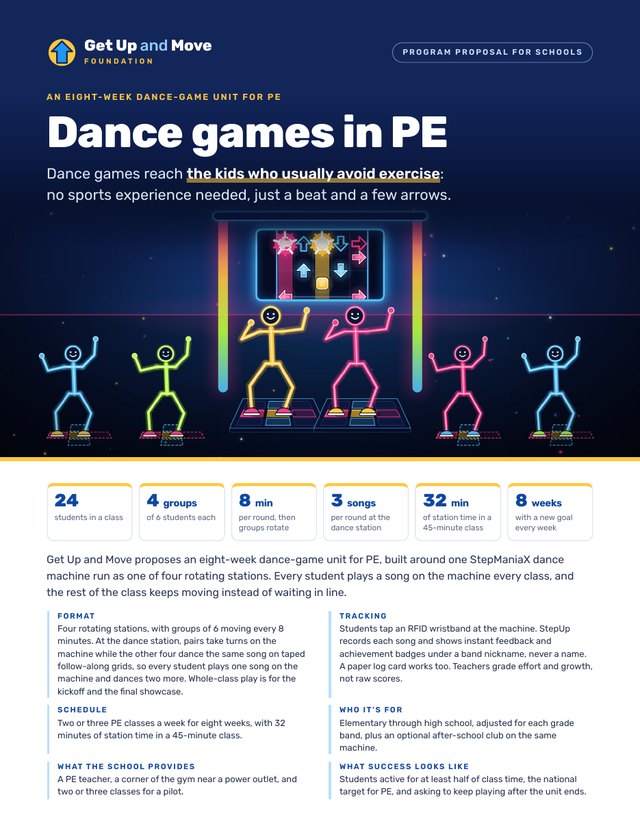
Program proposal
For principals and PE teams: why dance games reach kids who avoid exercise, how a class runs, tracking and badges, and the pilot plan.
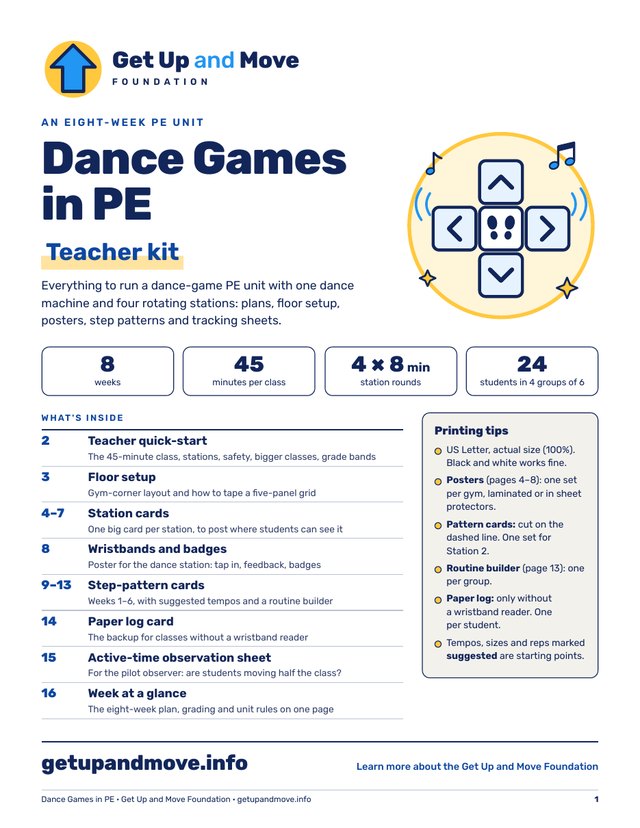
Teacher kit
Ready to print: the class plan, floor setup, four station posters, a log-in and badges poster, step-pattern cards, logs and the week-by-week plan.
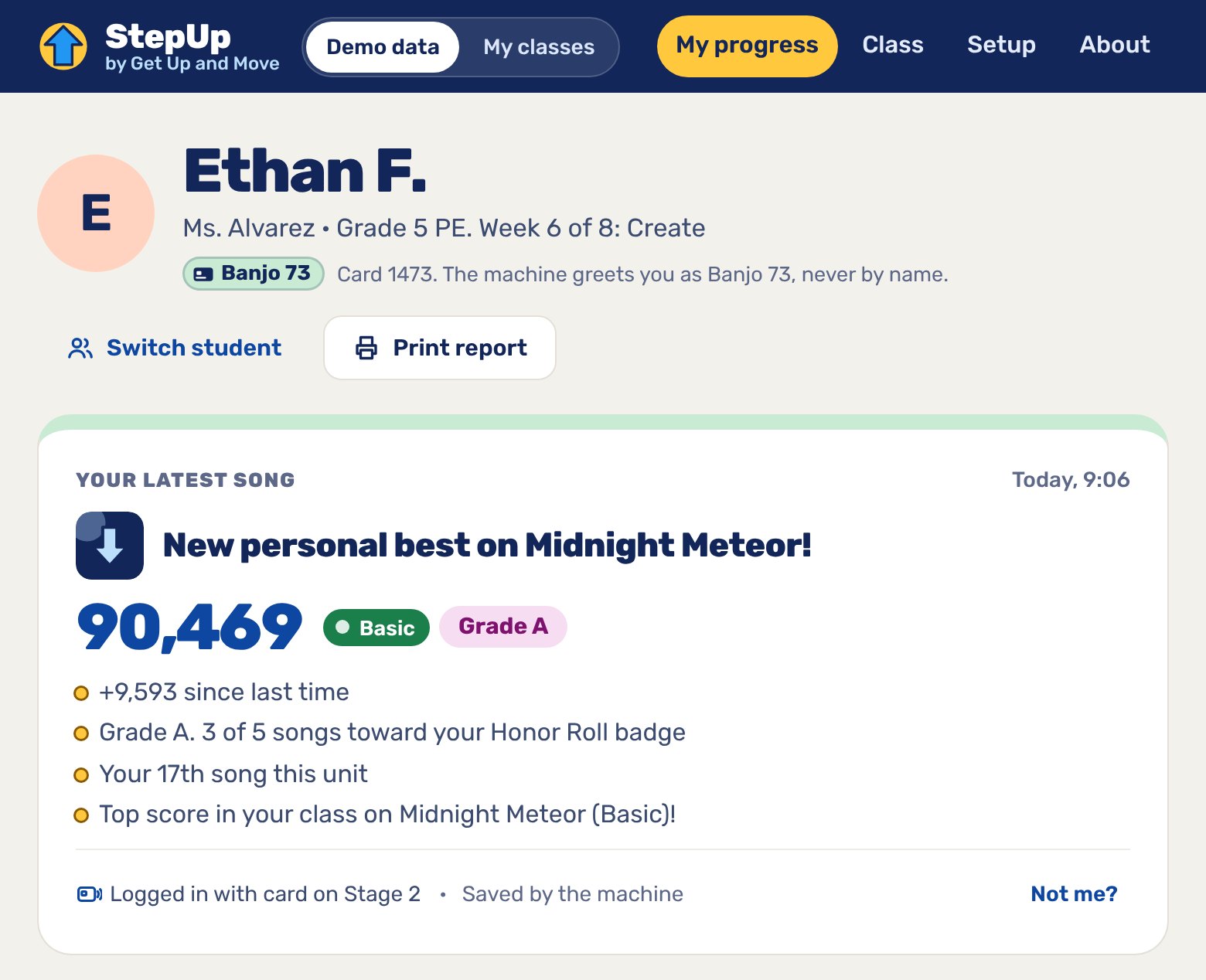
StepUp demo
A working prototype of what students would see: their songs, personal bests, levels and badges. Logging in on the machine with a card or a phone is planned.
Why dance games
Dance games reach kids that sports don’t. West Virginia brought Dance Dance Revolution into its schools after a West Virginia University professor saw kids lining up to play it at an arcade. THE Journal reported that “kids who would normally avoid regular exercise gravitate to DDR’s light and sound,” and that in the state’s first study, 50 overweight children who played at home became more confident in PE classes and more willing to try new activities (THE Journal, 2007). The state aimed to reach all 753 public schools, to appeal to students who often dislike other sports (NBC News).
- It’s real exercise. In a lab study of children averaging 11½ years old, Dance Dance Revolution averaged 5.4 METs, more than walking at 3 mph (4.9 METs). The researchers called that intensity consistent with activity recommendations for children (Bailey and McInnis, 2011).
- Fitness and grades improved in a Utah school study. At Rose Park Elementary in Salt Lake City, 85 fourth-graders did 30 minutes of dance games, aerobic dance and jump rope three times a week for 9 months. Compared with 123 third- and fifth-graders who didn’t, they were more likely to hold or improve their 1-mile run result, and their math grades rose more: 0.68 points against 0.21 (Gao, Salud America brief).
- It serves the national PE targets. CDC guidance calls for 150 minutes of PE a week in elementary school, 225 minutes in middle and high school, and students physically active for at least 50% of class time (CDC).
How a class runs
A 45-minute class has 32 minutes of station time: a short warm-up, then four 8-minute rounds for four groups of 6. At the dance station, each pair plays one song on the machine while the other four dance the same song on taped follow-along grids, so every student plays a song on the machine and dances two more.
A 45-minute class of 24: a warm-up, four 8-minute rounds at four stations, then a cool-down.
Minute by minute
- 0–4 Warm-up, whole class. Dynamic stretches to music, then the week’s step pattern on the floor grids together.
- 4–6 Challenge and groups. The teacher shows this week’s challenge and sends four groups of 6 to their first stations.
- 6–39½ Stations. Four rounds of 8 minutes, starting at 6, 14½, 23 and 31½, with a 30-second whistle to rotate clockwise. At the dance station, the group plays three songs, one pair per song.
- 39½–43 Cool-down. Walking, stretching and a quick effort check on a 1–10 scale.
- 43–45 Wrap-up. Students fill in one row of their log card: the song they played on the machine, its level and score, and their effort for the whole class. Once StepUp login is ready, the machine saves the song for them.
Bigger classes. The plan is built for 24. For up to 30 students, make five groups of 6 and add a fifth station, such as an agility ladder or a second set of floor grids. Five rounds take about 54 minutes. In a shorter period, run four rounds and start the next class where you left off. If a group has an odd number, one student plays solo.
Why stations instead of the whole class at once
The figures below assume a class of 24, one machine with two stages, and about 2½ minutes per song, including picking it.
| Whole class | Rotating stations (recommended) | |
|---|---|---|
| How it runs | Two students dance; the rest follow along on taped grids or cheer; swap every song | The dance game is 1 of 4 stations; groups of 6 rotate every 8 minutes |
| Stage time per student | One song, after up to 28 minutes of waiting | One song on the machine, plus two more on the follow-along grids |
| What everyone else does | Mostly waits; only students who can see the screen can follow along | Works at fitness stations that use the same steps and rhythm |
| Best for | Kickoff day, the final showcase, clubs, small groups | Everyday PE |
Whole-class play becomes practical every day once there is about one stage per 4 students: 6 stages, or 3 machines, for a class of 24. A school with a second machine can run two dance stations, so each student plays two songs on a machine every class.
The eight-week unit
Each week brings a new goal, so the challenge keeps growing past the point where interest usually dips (Sun, 2012). Students pick their own difficulty level (Beginner, Easy, Hard or Wild), and goals compare each student with their own earlier results, never with classmates.
| Week | Focus | Dance-game goal | Other stations |
|---|---|---|---|
| 1 | Learn the stage | Clear one song on Beginner; use the bar for balance | Name the five panels; step on the beat |
| 2 | Find the beat | Clear two different Beginner songs | 8-step pattern cards |
| 3 | Stamina | Dance all three songs in the round without a break: one on the machine, two on the grids | 16-step patterns; 1-minute jump-rope sets |
| 4 | Level up | Try Easy; replay the week 1 song and compare scores | Mid-unit check of effort and logs |
| 5 | Speed and accuracy | Beat your own week 2 score on the same song | Faster tempo on pattern cards |
| 6 | Create | Hard for confident students, Easy for the rest | Groups build an 8-count routine on the grids |
| 7 | Team play | Try team mode with your partner | Rehearse routines; teach yours to another group |
| 8 | Showcase | Personal-best day: replay your favorite song | Perform routines for the class |
By grade level
| Grade band | Station rounds | Song selection | Emphasis |
|---|---|---|---|
| Elementary (K–5) | 4 × 6 minutes in a 30-minute class, with shorter songs | Teacher or a helper, from a short preset list | Rhythm, the five panels, taking turns; picture-based pattern cards; Beginner and slower speeds through week 4 |
| Middle school (6–8) | 4 × 8 minutes | A student “DJ” role that rotates daily | Personal goals, stamina, building routines |
| High school (9–12) | 4 × 8 minutes, twice through in a 90-minute block | Students | Planning their own workout playlist, tracking effort, leading stations and designing pattern cards for younger classes |
For students with disabilities, the support bar, slower song speeds and seated versions of the strength exercises keep everyone in the rotation.
After school, too
On days the machine isn’t in PE, it can host an after-school dance club. Up to 12 students fit one machine: two dance while the other ten follow along on the gym’s taped grids, so each student gets two or three songs on the machine in an hour.
| Time | What happens |
|---|---|
| 0–10 min | Warm-up, then the week’s step pattern on the grids |
| 10–45 min | Song rotation: two on the stages, the rest following along, swapping every song; students choose their own level |
| 45–55 min | Small groups practice an 8-count routine |
| 55–60 min | Cool-down, and everyone logs their songs |
Older students can lead the club and coach younger ones, and a monthly showcase gives families a reason to come and watch.
Tracking progress
Teachers grade effort and growth, not game scores, so a beginner who improves earns as much as a student who was already good.
- A log card for every student. Students write the song, level, score and effort (1–10) on a paper log card. Logging in on the machine is planned: each student would tap a card or scan its on-screen QR code with a phone, and every song’s level and score would save to their account.
- Three checkpoints. In weeks 1, 4 and 8, each student replays the same song at the same level, so growth shows in one number.
- Active time. During a pilot, an observer times how many minutes students are moving, to check the class against the 50% target.
- Fitness tests, optional. Schools that already run a mile run or PACER test can compare results before and after the unit.
StepUp: progress saved from the machine. We’re building StepUp, where students and teachers follow progress. The plan: before playing, each student logs in on the machine by tapping a card or scanning the QR code on its screen with their phone. Every song then saves to that student’s own account, so the stats add up to the right person with no typing. Students see their songs, personal bests, levels and achievement badges, such as a new personal best, Hard Worker for effort, Steady Dancer for dancing on 10 different days, or Checkpoint Climber for beating their own week-1 checkpoint score. The machine’s screen shows a nickname, never a name. Teachers see who hasn’t danced this week, who is ready for the next level, badges earned, and active time against the 50% target. See the StepUp demo.
National PE standards
The unit maps onto all four of SHAPE America’s National Physical Education Standards:
| Standard | How the unit meets it | Evidence for the teacher |
|---|---|---|
| 1. Develops a variety of motor skills | Footwork patterns, rhythm, balance, coordination at speed | Checklist from the step-pattern station |
| 2. Applies knowledge related to movement and fitness concepts | Warm-up and cool-down, the effort scale, why leg strength helps on faster songs | Exit question on the log |
| 3. Develops social skills through movement | Taking turns, cheering, team routines, teaching another group | Teacher observation in weeks 6–8 |
| 4. Develops personal skills, identifies personal benefits of movement, and chooses to engage in physical activity | Personal goals, choosing a level, the optional club | Goal sheet, logs and club attendance |
Space, equipment and safety
The dance station needs a corner of the gym near a standard outlet. Plan a zone of about 20 by 20 feet for the machine and four taped follow-along grids where students can see the screen; we check the exact space on a site visit.
| Setup | What’s included | Size and weight | Power |
|---|---|---|---|
| StepManiaX DX cabinet | 65″ touchscreen, two five-panel stages, built-in sound system, a family filter for the song list | 75″ wide × 95″ deep × 94.5″ tall installed | 110 V |
| Two stages + touch monitor | 43″ touch monitor with the game built in, two stages; speakers separate. Sold out at Step Revolution in October 2026. | Each stage 35″ × 47″ × 7″, 220 lb | 100–240 V |
Safety rules for the dance station
- Sneakers with laces tied; no socks only and no sandals.
- One student per stage, always, and hands on the bar through week 3.
- Step off forward or to the side, never backward.
- Anyone can step off at any time; the effort scale tells the teacher who needs a break.
- The teacher stands where they can see the dance station and at least one other station.
- Wipe the bars and touchscreen between classes, and run power cords along the wall.
Start with a pilot
We start with one eight-week pilot at one school, with two or three classes, and then decide together whether to expand.
- Two weeks before. Visit the site, pick the spot, set up the dance station, tape the grids, hand out log cards, and walk the PE teacher through the routine.
- Week 0. A short student survey on how much they enjoy PE, plus any fitness test the school already runs.
- Weeks 1–8. Run the unit, with a weekly check-in and active-time observations in weeks 2 and 6.
- Week 9. Repeat the survey and review the results together.
| Get Up and Move brings | The school brings |
|---|---|
| Help setting up the dance-game station (we’ll work out the machine with each school) | A PE teacher and two or three classes |
| Station cards, pattern cards and log cards | Gym space near an outlet |
| A teacher walkthrough and weekly check-ins | Time for the before and after survey |
| A results summary at the end | Permission for observers in class |
The pilot is a success if observed students are active for at least half of class time, most students improve their checkpoint score between weeks 1 and 8, enjoyment of PE holds steady or rises, and the teacher wants to keep going.
Bring dance games to your school
PE teachers, principals and after-school coordinators: tell us about your school.
Sources: Bailey and McInnis, Archives of Pediatrics & Adolescent Medicine, 2011 (ScienceDaily summary) · Project GAME research brief, Zan Gao, Salud America! · W. Va. schools try video game to fight obesity, NBC News · Gaming: Eat Breakfast, Drink Milk, Play Xbox, THE Journal, 2007 · CDC, Comprehensive School Physical Activity Programs: A Guide for Schools · Haichun Sun, Exergaming impact on physical activity and interest in elementary school children (2012) · 2024 National Physical Education Standards (SHAPE America) · StepManiaX DX · Step Revolution shop